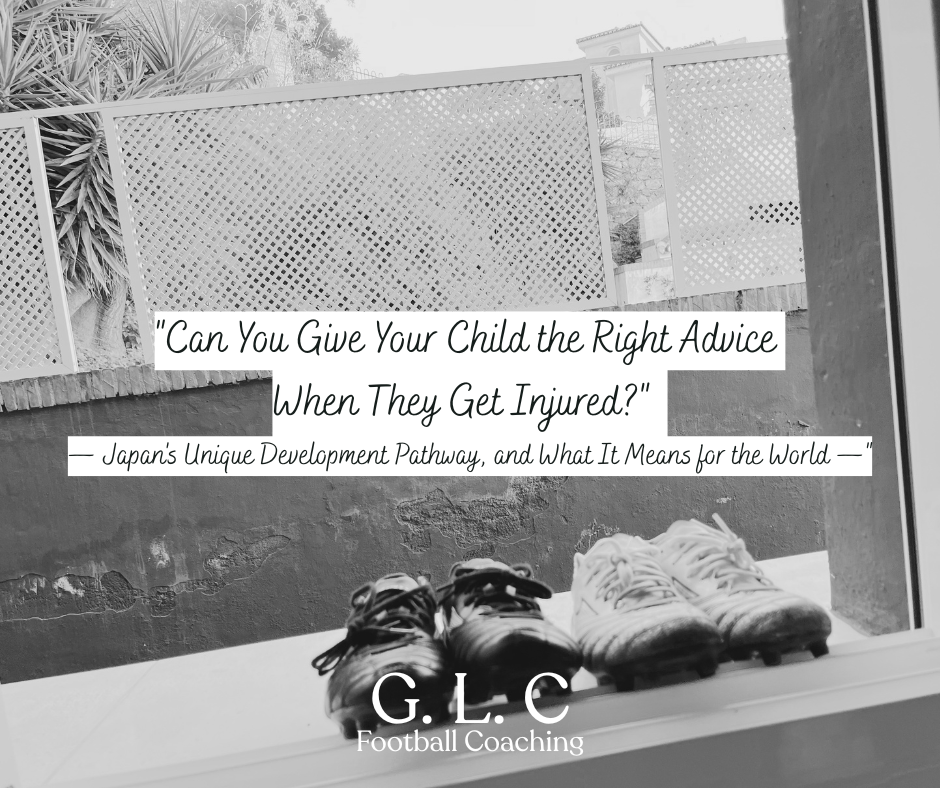
Introduction | Can You Give Your Child the Right Advice When They Get Injured?
“My knee hurts.” “Something feels off with my ankle.”
When your child says something like this after a match or training session, how do you respond?
“You’ll be fine by tomorrow.” “Everyone else is doing the same amount of training.” — It’s completely natural to want to say something reassuring. But sometimes, those words can lead to consequences you didn’t expect.
Injuries in young players carry different risks compared to adult injuries. And how parents and coaches respond can have a significant impact — not only on recovery, but on how a child learns to deal with injury throughout their sporting life.
I am not a medical professional. But having played football for many years and worked with young players as a coach, there are things I have come to feel strongly about. I hope this article can offer a small but useful perspective the next time your child comes to you with a pain or injury.
Injuries Come in Two Types
First, there is something worth knowing. When we say “injury,” the word covers two very different things.
The first is an acute injury. This happens in a single moment — a fall, a collision, or an awkward landing. Sprains, bruises, and muscle tears fall into this category. The defining feature is that you can point to exactly when and where it happened.
The second is an overuse injury. This develops gradually, through repeated movements and the accumulation of load over time. It is hard to say exactly when it started, and it tends to worsen slowly. It often shows up as pain in the knees or feet, and because it is not always visible, it is easy to overlook or dismiss.
In youth football, it is this second type that demands particular attention. A child’s body is still developing, and the bones and tendons are far more vulnerable to repeated stress than those of an adult. What seems like “just a little soreness” can, if ignored, become a long-term problem. That is what makes injuries in young players so difficult to manage.
What You Should Know About the Young Athlete’s Body
A child’s body during a growth phase has characteristics that are simply different from an adult’s.
As bones grow, there are areas called growth plates that remain soft and not yet fully formed. During this period, repeated or excessive load on these areas can affect the developing bones and tendons in ways that would not apply to a fully grown body.
There is also a common pattern during growth spurts where bones lengthen rapidly, but the surrounding muscles and tendons struggle to keep pace. This can cause the body to become tighter and less flexible, temporarily raising the risk of injury.
None of this means your child’s body is weak. It is simply evidence that they are growing — and that the right amount of load management and rest is needed to match where they are in that process.
“It’s probably fine” is a judgment that even professionals find difficult to make with confidence. If pain persists, please don’t hesitate to consult a medical professional or a sports specialist sooner rather than later.
“Push Through the Pain” — Japanese Club Culture and the Virtue of Endurance
Let me share something from my own experience growing up playing football in Japan.
Playing through a muscle tear with a taped-up leg was seen as proof that you were giving everything.
“Taking a rest for a little pain? Absolutely not. If it’s not a broken bone, it’s not an injury.”
Taking a rest for minor pain was quietly regarded as a lack of mental strength. Being told “don’t be soft over a bit of pain” was not unusual — it was just part of the environment.
In Japanese sport, particularly in the school club system known as bukatsu, there is a deeply rooted belief that pushing through pain is a virtue. The spirit of facing hardship and refusing to give up is not something I want to dismiss entirely. That kind of resilience genuinely has value.
But I do think there is a problem with applying that mindset specifically to physical pain.
Pain is a signal from the body. It is a warning — “too much load is being placed here,” or “continuing like this is going to cause damage.” Ignoring that signal is not a demonstration of strength. It is simply adding risk to the body, one session at a time.
The coaches who taught this way were not acting out of bad intentions. They were products of the same environment. And so the culture passed naturally from one generation to the next. That, I think, is what makes it so difficult to challenge.
What I Saw in New Zealand and Spain
From my time playing and observing coaching in New Zealand and Spain, there is something that has stayed with me.
When a player reported pain or injury and stepped away from training, it was not treated as anything unusual. It was not criticized. Resting and returning was simply understood as a normal part of the process.
And when a player said “it hurts,” the first response from the coach was to ask where, and how. Not “can you still go?”
I don’t think this reflects a lack of seriousness or a relaxed attitude toward the game. It felt more like a shared understanding — that knowing the condition of your body and managing it properly is directly connected to performance. That premise was built into how coaching was approached.
I am not trying to say one culture is right and the other is wrong. But the fact that “common sense” around injury looks so different depending on where you are — that, I think, is worth being aware of.
Knowing When to Rest Is a Skill
The feeling that resting means falling behind, or that it is a sign of weakness — for anyone raised in Japanese sporting culture, that feeling can become deeply instilled without you even noticing. It certainly was for me.
But now I genuinely believe that the ability to make the right call about when to rest is one of the most important skills a player can have.
From a sports science perspective, appropriate rest and recovery are essential components of improving performance. Continuing to train through accumulated fatigue does not allow the body to adapt — it simply raises the risk of injury further.
Building the habit early — feeling pain, saying so honestly, and resting when necessary — is one of the most important foundations a young player can develop for a long sporting career.
There are many players who have pushed through and ended up with a serious long-term injury as a result. I have had my own version of that experience too.
A Note for Parents | Creating a Space Where “It Hurts” Can Be Said
One thing I want to leave with parents before closing.
Creating an environment where your child feels safe saying “it hurts” honestly — that in itself is one of the most effective things you can do to prevent injury.
If a child repeatedly hears “we’ve got a match, you can’t rest now” or “aren’t you exaggerating?”, they will gradually stop saying it. And they will keep pushing through.
When your child tells you something hurts, try starting with: “Where does it hurt, and what does it feel like?” That one question, asked genuinely, can change how willing they are to be honest with you.
And when you are unsure, please don’t hesitate to seek professional advice. There is no need to feel like you are overreacting by getting it checked out. Acting early is what prevents small problems from becoming bigger ones.
Closing | How You Respond to Injury Is Part of Development Too
Injury is unavoidable in football. The question is not whether it happens, but how it is met — how it is understood, and how it is handled.
Being able to say “it hurts.” Being able to choose rest. Being able to come back.
These are not signs of weakness. They are signs of a player who is learning to listen to their own body. Whether that habit takes root during the youth years depends, to a large degree, on the adults around them.
At Glocal Football, we want to create an environment where children can hear what their body is telling them — and we consider that just as important as anything we teach on the pitch.
That said, knowing how to respond to injury is only part of the picture. The next question naturally follows:
What can we actually do to prevent injury in the first place?
Warm-ups, daily body care, managing training load — there are practical steps that young players and parents can take together. In the next article, we will look at specific injury prevention strategies that can be built into everyday football life.